
 SIGN IN
Landmark Report Argues Singing for Young Mental Health
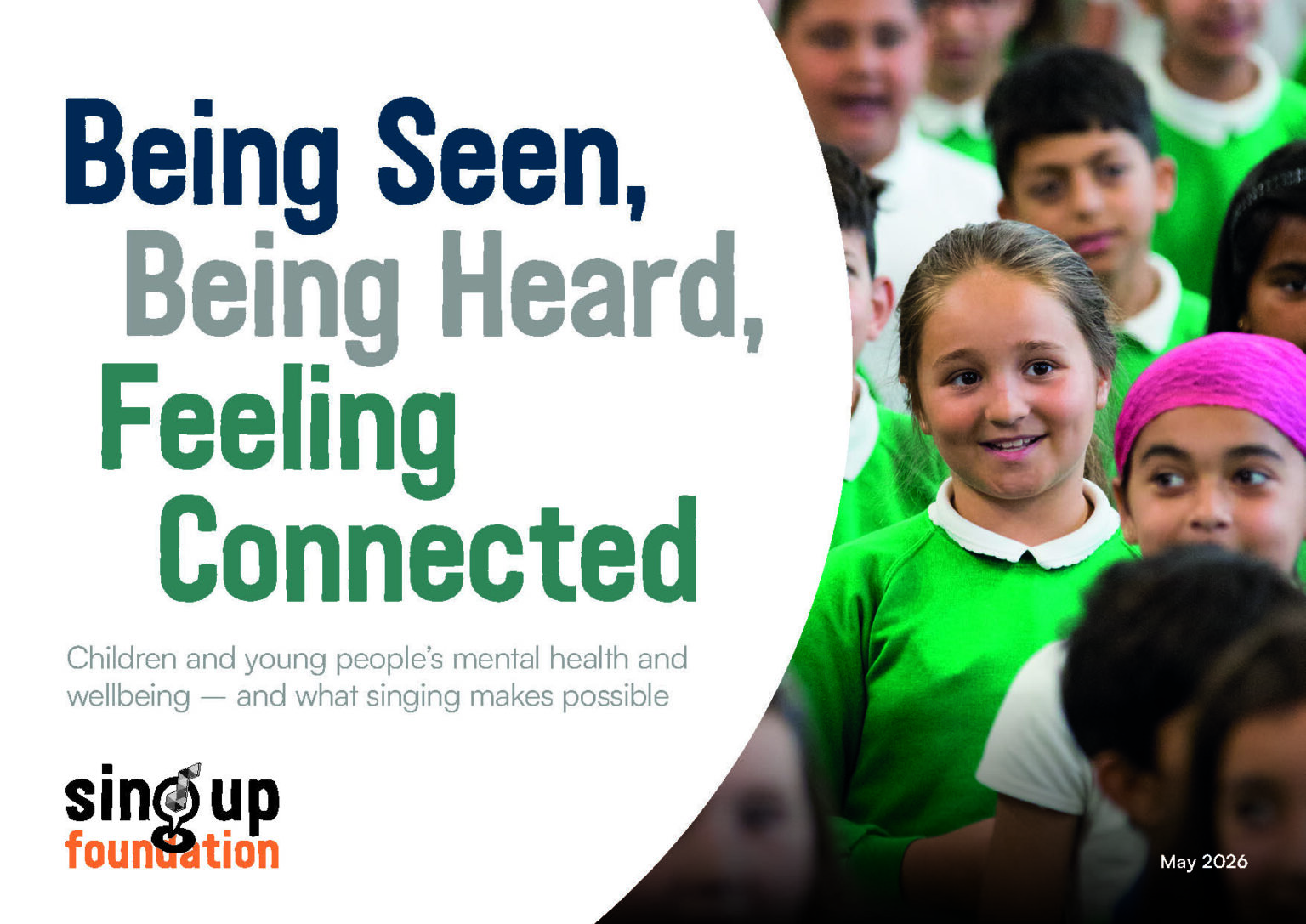
Singing could be the mental health intervention young people need, landmark report argues
Young people aged 18-24 are experiencing the poorest mental health of any age group in the UK, with one in three reporting symptoms of anxiety and/or depression, rising to two in five for young women[1]. A first-of-its-kind report from Sing Up Foundation, launching on 13 May to coincide with Mental Health Awareness Week, explores how singing and vocal work can play a vital role in addressing the mental health crisis facing young people.
Being Seen, Being Heard, Feeling Connected draws on over 50 sources, including practitioner insights, research, case studies and young people’s lived experiences. For the first time, it brings together decades of national and cross-sector learning on the power of the voice – making the case for singing not just as a creative activity, but as a tool for connection, expression and recovery, and as a targeted intervention for young people’s mental health.
Vocal leader Jane Wheeler, who has spent years leading singing with young people across Newham in London and internationally with the British Council, reflected on the changes she consistently observes in young people involved in singing groups, speaking on the Sing Up Foundation’s Inspiring Voices podcast: “It’s a way of being acknowledged and recognised and seen, and to be accepted for your sound and your voice.”
At the heart of the report is a simple but powerful idea: many mental health challenges are rooted in disconnection – from self, from others, and from a sense of belonging. Singing, the report suggests, can help rebuild these connections across multiple levels – emotional, social and physiological – when delivered in the right conditions.
From group singing that builds belonging, to songwriting that allows for emotional expression, the evidence shows consistent benefits. These include improved mood, reduced stress, increased social connection and a stronger sense of identity.
However, the report is clear: singing is not a quick fix. Its impact depends on skilled practitioners, safe environments, and sustained engagement over time.
“Practitioners are already stepping into the gap left by overstretched mental health services, using singing to support vulnerable young people. This publication maps that vital work. It shows us that with the right conditions and a properly supported workforce, collective singing and vocal work offers a powerful complement to those struggling with their mental health.” Baz Chapman, Joint Head of Sing Up Foundation
Being Seen, Being Heard, Feeling Connected positions singing not as a replacement for clinical services, but as a complementary approach that can extend reach, engage those who may not access traditional support, and help relieve pressure on overstretched systems.
The Sing Up Foundation urges greater investment in training, infrastructure and evidence-building to unlock the full potential of singing as part of a broader mental health response.
On 13 May, the report will be available for download from the Sing Up Foundation website (www.singupfoundation.org) and will be launched with a free webinar featuring a panel discussion with Professor Graham Welch (UCL Institute of Education), Ben Turner (Rap Club) and Baz Chapman, facilitated by Katherine Zeserson (Chair, Sing Up). Register at bit.ly/SUFWebinar
About the Sing Up Foundation
The Sing Up Foundation is a charity working to improve children and young people’s mental health and wellbeing through singing and vocal work. It brings together research, practice and lived experience to explore how singing and vocal work can support healthier, more connected lives.
[1] Health Foundation (2024), Young People’s Future Health Inquiry. Available at: https://www.health.org.uk/features-and-opinion/blogs/what-is-happening-to-young-people-s-mental-healthhttps://www.health.org.uk/young-peoples-future-health-inquiry
Last updated 06 May 2026